
All-Day Pre-K: Mastering School Readiness Skills

Imagine a child’s full day at school: beginning with a warm morning hug, progressing through hours of enthusiastic exploration, followed by a peaceful afternoon nap, and concluding with creative art projects. For many families, the transition from the constant presence of home to a structured school environment marks a major life milestone. While some parents might initially consider part-time options, modern educational research increasingly shows that a half-day program is often insufficient for a child to fully absorb essential developmental skills. Choosing a high-quality all-day preschool is about more than just finding a convenient schedule for working parents; it is about providing a dedicated space where a child can build a solid foundation for the future. This comprehensive guide explores how an all-day Pre-K program helps young learners naturally and joyfully master school-readiness skills. Leading institutions, such as Pacific Academy Costa Mesa, demonstrate that a structured, all-day Pre-K program can effectively support both academic readiness and long-term development.
1. Why All-Day Pre-K Offers More Than Childcare
Understanding the difference between simple supervision and true educational nurturing is crucial when evaluating early childhood programs, especially when choosing an all-day Pre-K or all-day preschool model. An all-day preschool program is designed to capitalize on the "golden window" of brain development, a time when young children are uniquely receptive to new linguistic patterns, social cues, and cognitive concepts.
1.1. The Power of Rhythm and Consistency
A full-time schedule provides a consistent rhythm that helps children build a stable biological clock. When a child follows a consistent and predictable daily routine from morning to late afternoon, their sense of anxiety often decreases because they know what to expect throughout the day. This consistency fosters a deep sense of security and emotional safety, which is the primary requirement for meaningful learning. Within this stable environment, students are not rushed from one activity to another; instead, they have the time to settle into their tasks and engage deeply with the material.
1.2. Continuous Nurturing and Education
Unlike traditional childcare, which might focus solely on physical safety and basic needs, a high-quality all-day Pre-K environment nurtures the whole child. Every moment of the day, from lunchtime conversations to collaborative play on the playground, is viewed as a "teachable moment". This instructional approach facilitates the ongoing development of children’s social interaction, problem-solving abilities, and capacity to engage with and explore their surrounding environment.
2. How All-Day Pre-K Builds School Readiness Skills
The primary goal of a high-quality all-day Pre-K program is to ensure that students are fully prepared for the academic and social transitions of elementary school. School readiness is a multidimensional concept encompassing cognitive abilities, social-emotional maturity, and physical independence.
2.1. Cognitive and Literacy Development
In a full-day setting, children have significantly more time to immerse themselves in learning projects and storytelling, which is similar to what families often seek when exploring private kindergarten options in Orange County that prioritize long-term academic development. This extended time is essential for developing a longer attention span, as students engage in various morning and afternoon group activities.

Pacific Academy uses a successful trilingual curriculum that immerses students in English, Mandarin, and Spanish. This multilingual approach enhances cognitive growth and global awareness from a very young age. Furthermore, the school employs the Singapore Math methodology to foster deep conceptual understanding of mathematics, emphasizing logic rather than rote memorization. Through project-based learning, students tackle real-world challenges and collaborate to create products for a real audience, helping them gain a deeper understanding of the subjects they are studying. Students often discover new ideas in a way that feels natural and engaging rather than forced.
2.2. Building Social-Emotional Intelligence
Mastering social skills is a cornerstone of school readiness. An all-day Pre-K environment provides countless "social touchpoints" throughout the day. During circle time, lunch, and collaborative projects, children learn how to wait for their turn, resolve conflicts when sharing toys, and express their emotions appropriately.
At Pacific Academy, Social Emotional Learning (SEL) is integrated into the daily routine. Teachers serve as mentors who model respect and kindness, creating a safe environment where every child can thrive. Leadership training also begins early through the "PA PRIDE" program, which focuses on Participation, Responsibility, Ingenuity, Determination, and Empathy. Students apply these values through structured discussions and collaborative group activities, fostering the self-assurance necessary to demonstrate leadership with integrity.
2.3. Fostering Independence and Self-Service
One of the most practical benefits of a full-day program is the development of independence. Children learn essential self-service skills that are vital for success in a more structured elementary environment. In an all-day Pre-K setting, students are taught how to clean up their own lunch trays, put away their sleeping mats after a nap, and manage their personal belongings. These daily habits build personal responsibility and the confidence that children need to take ownership of their own learning journey.
3. Benefits of All-Day Preschool for 3-Year-Olds
Many families wonder when the best time is to begin a full-time educational journey, as early experiences play a critical role in shaping a child’s development and long-term success. Research suggests that enrolling a 3-year-old in an all-day preschool offers significant long-term advantages compared to waiting until age 4 or 5.
3.1. Capitalizing on the Language and Social Explosion
The age of three is often marked by an explosion in language development and a growing need for social connection. By participating in an all-day preschool for 3-year-olds, children are given a stimulating environment that feeds this natural curiosity, similar to high-quality preschool programs in Orange County that emphasize early language and social development. The immersion in multiple languages at this stage allows for greater natural fluency, as children begin to sing songs and use foreign words as part of their daily lives.
3.2. Transforming Separation Anxiety into Confidence

For many three-year-olds, the initial transition to school can involve separation anxiety. In a full-day program, dedicated teachers have more time to build strong, trusting relationships with each child. They act as supportive guides, helping children navigate their initial fears and eventually turning the school into a "second home" filled with joy and security. This early experience with stability and teacher mentorship helps children become more resilient and adaptable in the long-term.
4. Physical and Creative Development in All-Day Preschool
A complete school readiness program in an all-day preschool must also address a child's physical and creative development. An all-day preschool offers children sufficient time to participate in both fine and gross motor activities, promoting balanced physical growth and coordination.
4.1. Motor Skills and Physical Fitness
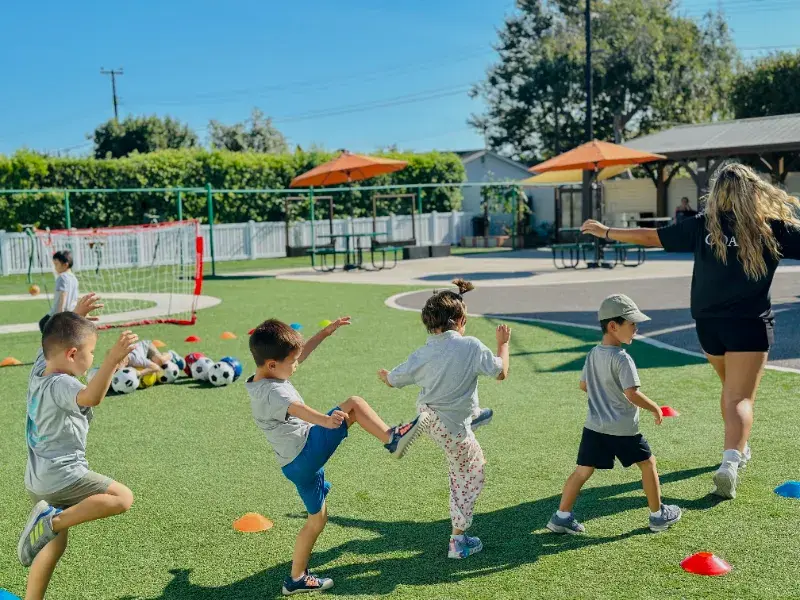
Ample time for outdoor play allows children to strengthen their gross motor skills through physical activities such as obstacle courses, running, and soccer. These activities promote healthy learning habits and teamwork. At the same time, classroom activities such as arts and crafts and handling pencils or scissors help children develop the fine motor control required for future writing tasks.
4.2. Spaces for Imagination and Play

Creativity is nurtured through imaginative play and dedicated art time. In an all-day preschool environment, children can explore "dramatic play" corners where they act out skits and storytelling, which helps them process their internal world and build communication skills. At Pacific Academy, the after-school program further enhances this creative growth through specialized clubs. Students can participate in Creative Art classes taught by professional artists, or join the Gardening Club to learn about the four seasons and irrigation through hands-on experience. Other unique opportunities include the Jr. Chef program, which introduces farm-to-table science, and DIY Rocketry, which sparks an interest in innovation and problem-solving.
5. Why Pacific Academy Costa Mesa Leads in All-Day Pre-K Education

Pacific Academy Costa Mesa (PACM) serves as a premier example of how a full-day environment can be utilized to its fullest potential. The academy is a place where every child is "seen, cared for, and inspired" throughout their entire day. As a top-ranked institution, ranked No. 2 Best K-12 Private School in Orange County, the academy maintains a reputation for academic excellence and innovation. Pacific Academy Costa Mesa is consistently recognized for its strong academic outcomes, small class sizes, and innovative trilingual curriculum, making it one of the most trusted private schools in Orange County.
5.1. The Philosophy of "The Opportunity to Be Me"
The school’s core philosophy, "The Opportunity to Be Me," emphasizes the uniqueness of each child and family. This child-centered mission ensures a safe, developmentally appropriate environment that fosters an instinct to explore and create. By prioritizing personalized attention, the academy encourages students to become enthusiastic, confident learners ready for a multicultural future.
5.2. A Balanced and Personalized Curriculum
A typical day at Pacific Academy is not about cramming information into young minds; instead, it is a rhythmic blend of academic instruction, artistic expression, outdoor play, and restorative rest. Small class sizes, with an average 4:1 student-to-teacher ratio, allow educators to act as mentors who understand each child's academic background and social-emotional needs. This individualized approach ensures that the curriculum is well-integrated and holistic, meeting students exactly where they are.
6. Conclusion
Ultimately, the quality of an all-day Pre-K program is not measured simply by how many letters or numbers a child can recite, but by a child’s confidence, independence, and enthusiasm for learning. A well-structured all-day preschool environment allows children to build strong academic foundations while developing the social and emotional resilience needed for long-term success.
Leading institutions such as Pacific Academy Costa Mesa demonstrate how a thoughtfully designed all-day Pre-K program can support both school readiness and whole-child development. Through a balanced approach that includes trilingual immersion, social-emotional learning, and personalized instruction, students are guided to become confident, curious, and globally minded learners.
Families exploring an all-day Pre-K program are encouraged to visit Pacific Academy Costa Mesa to experience its structured, nurturing, and engaging learning environment firsthand. Observing classrooms and interacting with educators can provide meaningful insight into how a high-quality all-day preschool supports early development.
For more information about admissions, families can contact Pacific Academy Costa Mesa at 833-796-5688 or via email at CostaMesa@PacificAcademy.org.


Comments